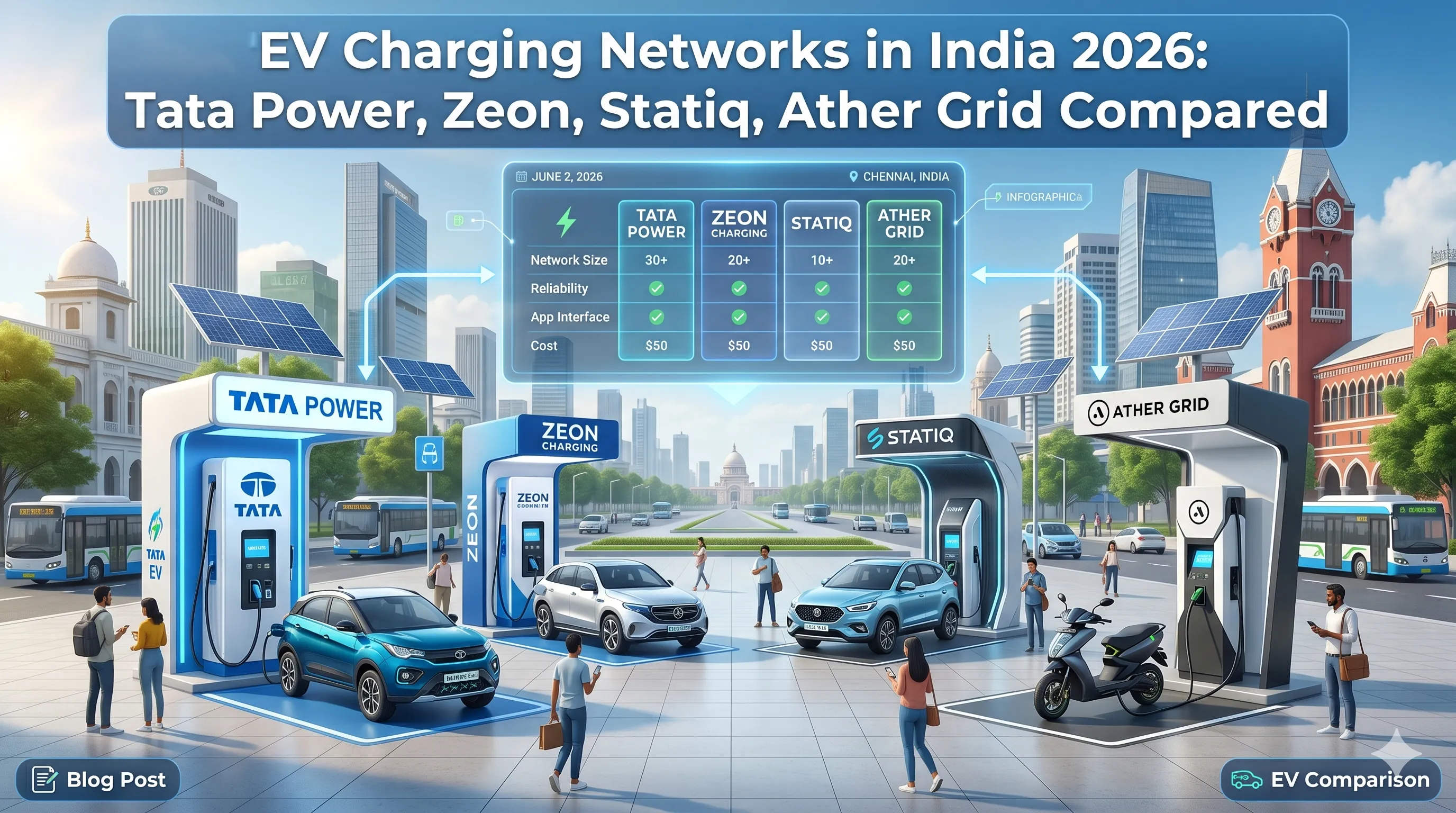
EV Charging Networks in India 2026: Tata Power, Zeon, Statiq, Ather Grid Compared
Introduction
When people discuss electric vehicles, they often focus on:
- Battery range
- Charging speed
- Vehicle pricing
- Features
But experienced EV owners know something important:
The charging network matters almost as much as the vehicle itself.
A great EV paired with poor charging infrastructure can quickly become frustrating.
Meanwhile, even moderate-range EVs become practical when supported by a reliable charging ecosystem.
In 2026, India's charging landscape has evolved dramatically.
Several companies are investing heavily in:
- Highway charging
- Urban charging
- Apartment charging
- Destination charging
Among the most recognized networks are:
- Tata Power EZ Charge
- Zeon Charging
- Statiq
- Ather Grid
Each follows a slightly different strategy.
And each serves a different type of EV owner.
External Resources
Official links and tools for charger discovery, network updates, and EV data:
- Tata Power EZ Charge: https://www.tatapower.com/ev-charging
- Zeon Charging: https://zeoncharging.com/
- Statiq: https://www.statiq.in/
- Ather Grid and public charging: https://www.atherenergy.com/grid
- NITI Aayog e-AMRIT (EV policy and guidance): https://e-amrit.niti.gov.in/
- National VAHAN dashboard (registration trends): https://vahan.parivahan.gov.in/vahan4dashboard/
Why Charging Networks Matter More Than Ever
The average EV owner today drives significantly more confidently than they did five years ago.
Why?
Because charging infrastructure is finally becoming visible.
Earlier Challenges
- Limited chargers
- Unreliable availability
- Poor app experiences
- Charging anxiety
What Changed
Today's EV owners increasingly expect:
- Easy charger discovery
- Fast charging support
- Reliable payment systems
- Real-time availability updates
Real Insight
Range anxiety is gradually being replaced by:
Charger reliability anxiety
Which means network quality matters enormously.
Tata Power EZ Charge: The Nationwide Giant
Tata Power has emerged as one of the largest charging infrastructure providers in India.
Key Strengths
- Massive charging footprint
- Presence across major cities
- Highway charging expansion
- Strong corporate backing
What Makes It Popular
Many EV buyers trust Tata because:
- The brand is familiar
- Service coverage is extensive
- Partnerships are widespread
User Experience
The network generally provides:
- Fast chargers
- AC chargers
- Fleet charging solutions
Best For
- Long-distance travelers
- Multi-brand EV owners
- Users seeking nationwide coverage
Real Insight
Tata Power's biggest advantage is scale.
Even when competitors offer better individual experiences, Tata often wins through sheer network presence.
Zeon Charging: The Highway Specialist
Zeon has built a strong reputation among highway EV travelers.
Core Strategy
Rather than focusing primarily on urban charging, Zeon aggressively expanded along key travel corridors.
Why This Matters
Highway charging remains one of the biggest barriers to EV adoption.
People want confidence that they can travel between cities comfortably.
Key Advantages
- Strategic highway locations
- Fast charging focus
- Reliable travel routes
Best For
Drivers who regularly travel between:
- Chennai and Bengaluru
- Chennai and Coimbatore
- Bengaluru and Mysuru
- Other major corridors
Real Insight
Many EV enthusiasts specifically plan road trips around Zeon's network availability.
That says a lot about consumer confidence.
Statiq: The Software-Driven Challenger
Statiq approaches charging differently.
Its biggest strength is not necessarily hardware.
It is software integration.
What Makes Statiq Unique
- Aggregated charging ecosystem
- Strong mobile app experience
- Broad charger discovery capabilities
User Benefits
Drivers can often:
- Find chargers quickly
- Access multiple charging providers
- Manage charging sessions easily
Why This Matters
Convenience increasingly influences EV ownership satisfaction.
Best For
- Tech-savvy EV users
- Urban commuters
- Users prioritizing app functionality
Real Insight
Charging networks are becoming software businesses as much as infrastructure businesses.
Statiq understands this trend well.
Ather Grid: Built for Two-Wheelers, Expanding Beyond
Ather Grid began as a network supporting Ather scooters.
Today, it has become one of India's most recognized EV charging brands.
Original Focus
- Electric scooters
- Urban charging convenience
- Destination charging
What Made It Successful
Ather focused heavily on:
- Reliability
- Simplicity
- User experience
Key Strengths
- Excellent urban coverage
- Strong charging uptime
- Familiar ecosystem for Ather owners
Best For
- Two-wheeler EV owners
- Daily commuters
- Urban riders
Real Insight
Ather Grid demonstrated that charging convenience can become a competitive advantage.
Coverage Comparison
Coverage remains one of the most important factors.
Tata Power
Strengths:
- Largest overall footprint
- Multi-city presence
- Rapid expansion
Zeon
Strengths:
- Strategic highway deployment
Statiq
Strengths:
- Broad charger aggregation
Ather Grid
Strengths:
- Strong urban scooter ecosystem
Real Winner
For sheer national presence:
Tata Power currently leads.
Charging Speed Comparison
Speed matters because nobody enjoys waiting.
Fast Charging Leaders
Typically:
- Tata Power
- Zeon
offer extensive DC fast charging support.
Urban Convenience Focus
Ather Grid often prioritizes:
- Quick top-ups
- Daily commuting needs
Statiq
Depends on partner infrastructure.
Real Insight
The fastest network is not always the most useful.
Convenience and availability often matter more.
Mobile App Experience
Charging apps have become a major differentiator.
What Users Want
- Live charger status
- Easy payments
- Route planning
- Charging history
Strong Performers
- Statiq
- Ather Grid
typically receive praise for usability.
Why This Matters
Poor apps create:
- Frustration
- Missed charging opportunities
- Reduced trust
Software quality increasingly influences charging satisfaction.
Reliability and Uptime
This is perhaps the most important metric.
A charger that exists but does not work is useless.
Key Considerations
- Maintenance quality
- Network monitoring
- Customer support
User Experience
Reliable charging creates confidence.
Unreliable charging creates hesitation.
Real Insight
Network uptime may become the most important competitive factor over the next five years.
Pricing Comparison
Pricing varies considerably.
Common Pricing Models
- Per kWh
- Per minute
- Session-based pricing
Consumer Priorities
Most users want:
- Transparent pricing
- Predictable costs
Market Trend
Competition is gradually improving affordability.
Real Insight
Charging pricing remains far cheaper than petrol or diesel refueling in most situations.
Which Network Is Best for City Users?
Urban EV owners prioritize:
- Charger accessibility
- App usability
- Convenience
Strong Choices
- Ather Grid
- Statiq
- Tata Power
Why
City drivers often charge:
- Frequently
- For shorter durations
Convenience becomes critical.
Which Network Is Best for Highway Travel?
Highway users have different priorities.
Requirements
- Fast charging
- Reliable locations
- Strategic route coverage
Top Contenders
- Zeon
- Tata Power
Why
These networks have invested heavily in intercity travel infrastructure.
Challenges Still Facing Indian Charging Networks
Despite rapid growth, problems remain.
1. Charger Availability
Popular chargers can become crowded.
2. Standardization Issues
Different networks still use varying systems.
3. Rural Coverage
Most expansion remains focused on urban and highway regions.
4. Maintenance Consistency
Some locations still experience downtime.
What the Future Looks Like
India's charging ecosystem is entering a new phase.
The focus is shifting from:
Building chargers
to
Building charging experiences
Emerging Trends
- Plug-and-charge systems
- AI-powered route planning
- Faster charging technology
- Smart energy management
Real Insight
The next winners may not necessarily be those with the most chargers.
They may be those with the best user experience.
The Bigger Picture
Charging infrastructure is becoming one of the most important pillars of India's EV transition.
The success of EV adoption depends heavily on:
- Charger reliability
- Network accessibility
- Consumer trust
Companies like Tata Power, Zeon, Statiq, and Ather Grid are helping solve those challenges.
And their competition benefits everyone.
Conclusion
So which charging network is best in India in 2026?
The answer depends on your needs.
Choose Tata Power if you want:
- Nationwide coverage
Choose Zeon if you prioritize:
- Highway travel
Choose Statiq if you value:
- Software experience
Choose Ather Grid if you primarily use:
- Electric two-wheelers in urban areas
The encouraging reality is that Indian EV owners no longer depend on a single charging provider.
Multiple strong networks now exist.
And that is one of the clearest signs that India's EV ecosystem is maturing rapidly.
FAQ
1. Which charging network has the widest coverage in India?
Tata Power currently offers one of the largest charging footprints.
2. Which network is best for highway road trips?
Zeon is widely recognized for its strong highway charging presence.
3. Is Statiq a charging provider or an aggregator?
Statiq functions both as a charging network and a platform helping users discover chargers.
4. Is Ather Grid only for Ather scooters?
No. Many locations are accessible to broader EV users, depending on charger type.
5. Will charging infrastructure continue expanding rapidly?
Yes. Growth in EV adoption is driving significant investments into charging networks across India.