The Real Cost of Owning an EV in India in 2026: Is It Actually Cheaper Than Petrol?
An electric vehicle can make a daily commute remarkably cheap. But does that mean it is cheaper to own?
Not necessarily. The answer depends on where you charge, how far you drive, which petrol or diesel vehicle you compare it against, and what you recover when you sell the car.
India's EV market is expanding, but the sensible question for a buyer in 2026 is not simply whether electricity is cheaper than petrol. It is whether the savings over five or eight years compensate for the purchase premium and ownership risks.
1. The Purchase Price Is Only the Beginning
Consider the updated Tata Punch EV, whose 2026 launch price began at ₹9.69 lakh ex-showroom. Tata also advertised a Battery-as-a-Service (BaaS) option beginning at ₹6.49 lakh plus ₹2.60 per kilometre in battery payments. These are not equivalent purchase offers: the second shifts some ownership cost into a recurring usage charge.
For comparison, a petrol Punch starts at a substantially lower price, although an appropriate comparison should match trim, transmission, equipment and on-road charges rather than merely comparing entry-level stickers.
| Purchase consideration | Petrol/diesel | EV |
|---|---|---|
| Initial vehicle price | Often lower in comparable mass-market segments | Often higher without battery leasing |
| Registration and road tax | Depends on state and vehicle | State concessions may apply; verify current policy |
| Home charger | Not needed | Wiring, installation or charger upgrades may cost extra |
| Financing | Interest on smaller loan may be lower | Larger financed amount can increase total interest |
| BaaS | Not applicable | Lower sticker price, but recurring per-km or subscription costs |
Important: The correct number for a financial comparison is the on-road price paid, including taxes, insurance, dealer charges and any charger installation—not just the manufacturer's advertised price.
2. Home Charging vs Public Charging: The Biggest Variable
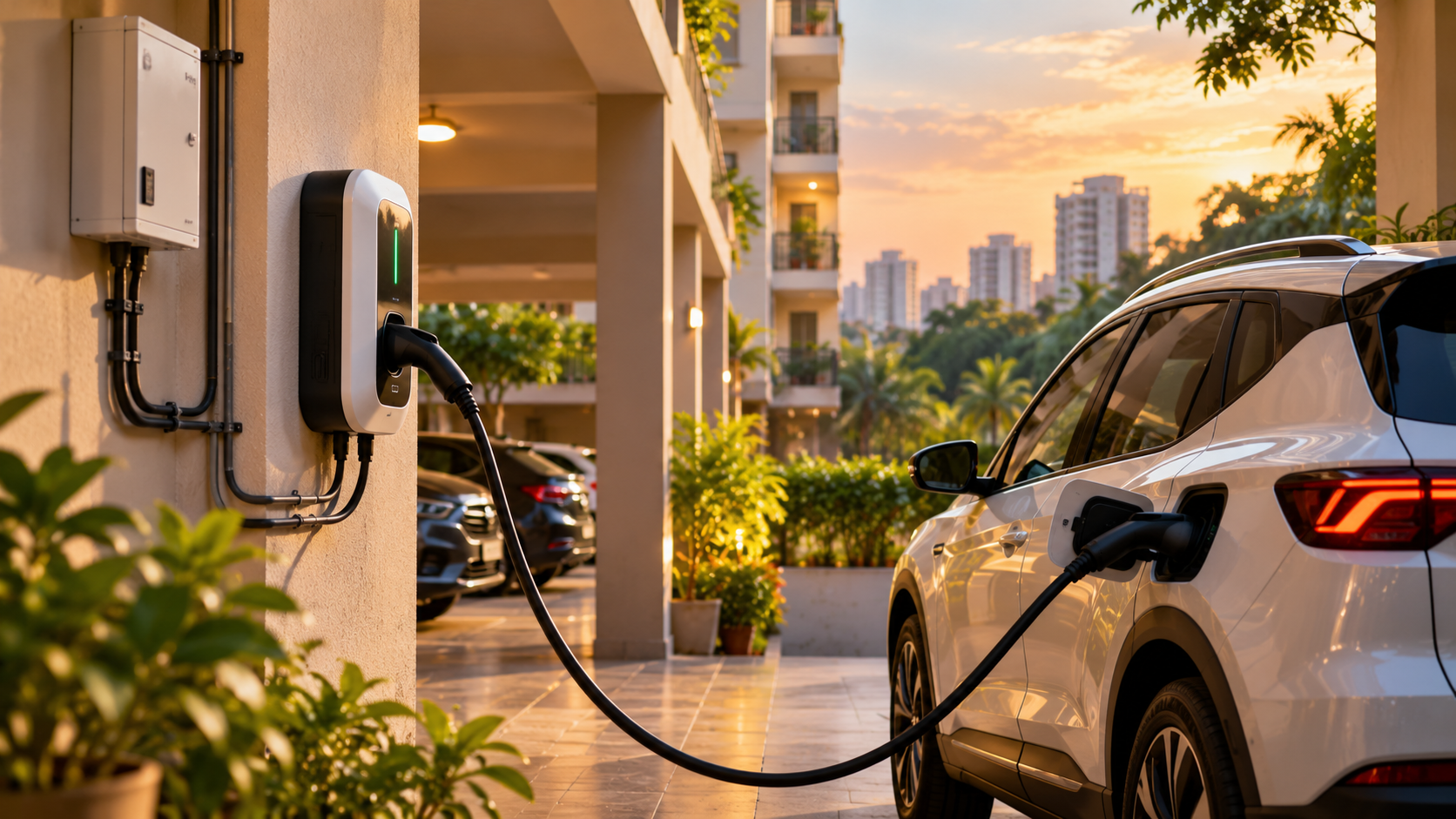
EV owners who regularly charge at home can enjoy substantial savings. Owners dependent on commercial fast chargers may have a very different experience.
Suppose an EV consumes 0.15 kWh per kilometre from the wall, including charging losses. This is an illustrative assumption, not a guaranteed efficiency for every car.
| Electricity price | EV electricity cost per km |
|---|---|
| ₹6/kWh | ₹0.90 |
| ₹8/kWh | ₹1.20 |
| ₹10/kWh | ₹1.50 |
| ₹15/kWh | ₹2.25 |
| ₹20/kWh | ₹3.00 |
| ₹25/kWh | ₹3.75 |
At 1,200 km a month, charging at ₹8/kWh would cost about ₹1,440. Charging the same distance at ₹20/kWh would cost ₹3,600.
Public charging can also include parking fees, idle fees, service charges or taxes. The effective price should be calculated from the final billed amount divided by energy delivered, not just the headline rate shown in an app.
3. Electricity Tariffs Are Different Across Indian States
There is no single nationwide household EV charging tariff. Domestic electricity is usually billed under state-specific tariff schedules, often with consumption slabs, fixed charges, subsidies and other adjustments.
| State / region | What buyers must check |
|---|---|
| Tamil Nadu | TANGEDCO/TNPDCL domestic slabs, applicable subsidies and whether added EV usage pushes the household into a higher slab |
| Karnataka | BESCOM or relevant DISCOM domestic tariff and any separately metered EV category |
| Maharashtra | MSEDCL or local distributor tariff, time-of-day provisions and EV charging classification |
| Delhi | Domestic subsidy eligibility, consumption thresholds and charging-station tariffs |
| Telangana | DISCOM domestic slabs and any EV-specific tariff |
| Kerala | KSEB domestic slab structure and applicable charging-station category |
| Gujarat | Distributor-specific residential tariffs and public charging pricing |
Why no single ₹/kWh number for each state? Tariffs depend on the DISCOM, billing category, monthly usage and effective date. A single number would misleadingly suggest that every household in the state pays the same marginal rate.
For a fair calculation, use the marginal cost of the extra units used to charge your EV. If charging raises your electricity bill by ₹1,500 for 180 kWh, the effective incremental tariff is ₹8.33/kWh—even if some of your earlier household units were subsidised.
4. Insurance: EV Repair Claims Can Be More Expensive
Lower running costs do not guarantee lower insurance costs.
Policybazaar data reported by Mint in October 2026 showed an average EV repair claim of ₹41,543, compared with ₹36,185 for petrol/diesel cars in a comparison of ₹10–15 lakh vehicles within their first three years, excluding large-loss claims. That is approximately 14.8% higher based on the published amounts.
The finding concerns average claim severity, not proof that every EV has a higher insurance premium or is more likely to have an accident.
Potential reasons for higher repair bills include battery-area inspections, specialised parts, electronic components and repair-network constraints. Premiums still depend on insured declared value (IDV), location, driver and vehicle history, insurer pricing, add-ons and no-claim bonus.
Before buying, obtain actual quotes for:
- Comprehensive insurance, including own-damage and third-party coverage
- Zero-depreciation and consumables add-ons
- Battery-related damage and water-ingress exclusions
- Roadside assistance and cashless EV repair network
A cheap first-year dealer policy is not a reliable estimate of what years two through five will cost.
5. Maintenance: Fewer Moving Parts, but Not Zero Bills
EVs do not require engine oil changes, spark plugs, clutch replacements or many conventional engine-service items. Regenerative braking may also reduce brake-pad wear.
However, tyres, suspension, air-conditioning, coolant systems, cabin filters, 12V batteries and software-related repairs remain relevant. Tyre wear can vary with vehicle weight, torque, driving style and alignment.
For an illustrative five-year budget, assume ₹5,000–₹10,000 a year in routine EV maintenance versus ₹8,000–₹15,000 for a comparable petrol car. Actual manufacturer service schedules and unexpected repairs may produce materially different results.
Battery replacement is the major tail risk. Check the warranty duration, kilometre limit, transferability, capacity-retention terms and exclusions. For example, Tata's 2026 Punch EV 40 kWh offering included a lifetime battery warranty under specified conditions, while its 30 kWh version had a different warranty structure. “Lifetime” must never be read as unconditional coverage for every owner.
6. Resale Value and Depreciation: The Hardest Cost to Predict
The five-year resale value can dominate relatively small annual maintenance savings.
Used-EV prices depend on battery health, remaining warranty, brand support, repair costs, charging compatibility and how much newer EVs have improved. Rapid price reductions for new models may hurt the resale value of older vehicles.
Consider a hypothetical ₹12 lakh EV. If it resells for ₹6 lakh after five years, depreciation is ₹6 lakh. If it resells for ₹4.8 lakh, depreciation is ₹7.2 lakh. That ₹1.2 lakh difference can erase years of electricity savings.
There is not enough evidence to assume a universal 2026 EV resale-retention percentage across all Indian models. Ask dealers for guaranteed buyback terms, inspect comparable used listings and request a battery state-of-health report when possible.
7. City Commuting: Where EV Economics Often Shine
Imagine a Chennai commuter driving 50 km on 24 days per month, or 14,400 km per year.
Assumptions for comparison:
| Input | Petrol car | EV |
|---|---|---|
| Real-world efficiency | 15 km/litre | 0.15 kWh/km from wall |
| Energy price | ₹100/litre | ₹8/kWh at home |
| Cost per km | ₹6.67 | ₹1.20 |
| Annual energy cost | ₹96,000 | ₹17,280 |
The EV saves approximately ₹78,720 a year on energy alone. If the EV costs ₹3 lakh more upfront, a simple energy-only break-even would occur after approximately 3.8 years, or 54,900 km.
That is not a full ownership break-even: financing, maintenance, insurance and resale differences still matter. But the example shows why a regular city commute with dependable home charging is an attractive EV use case.
8. Highway Driving: Fast Charging Changes the Equation
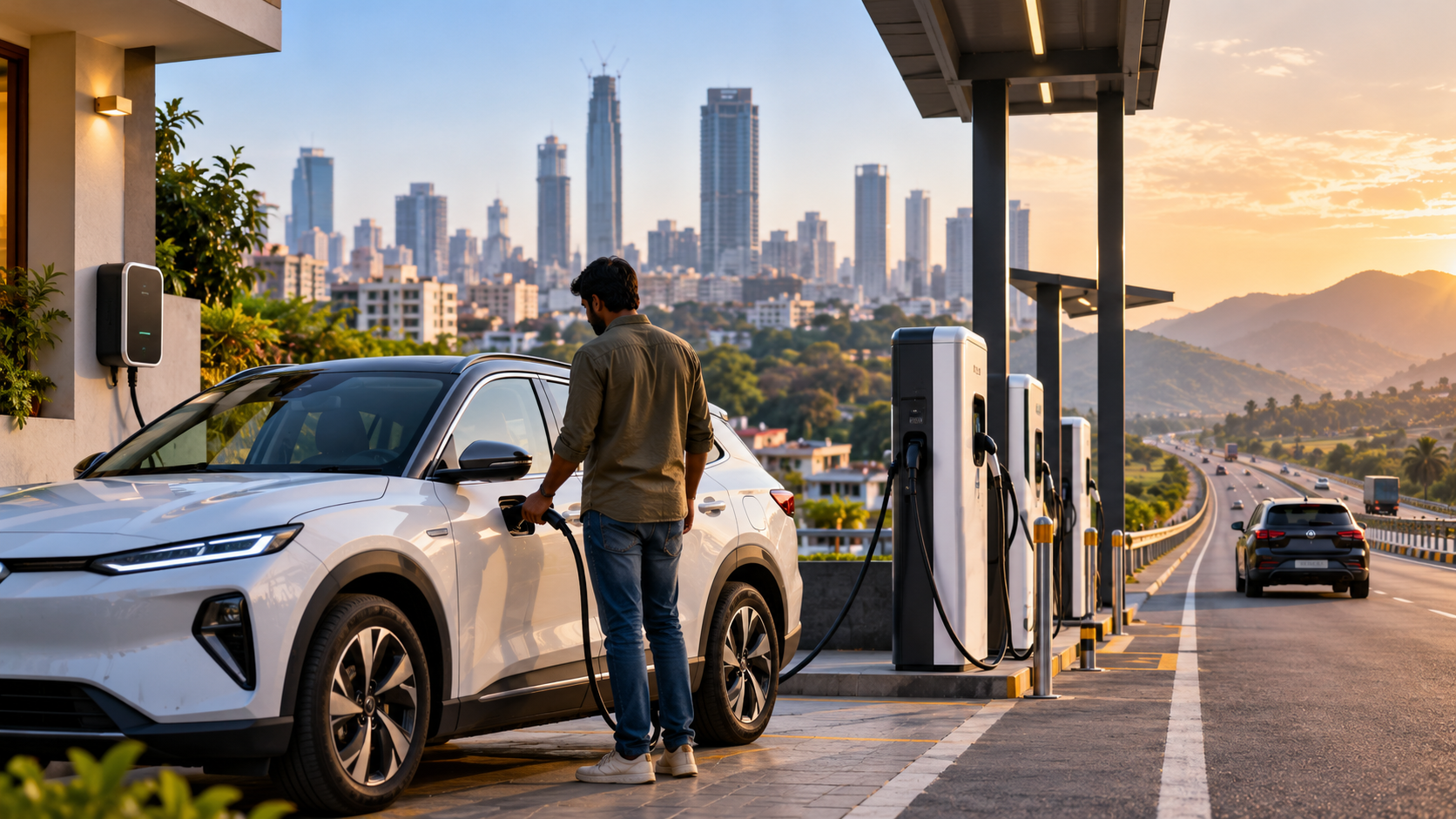
Now consider a driver travelling 600 km on a weekend road trip, mostly at highway speeds.
Assume petrol mileage improves to 18 km/litre, while EV consumption rises to 0.19 kWh/km from the wall or charger. Use ₹100/litre for petrol and ₹20/kWh for commercial charging.
| Metric | Petrol | EV on public charging |
|---|---|---|
| Energy consumed | 33.3 litres | 114 kWh |
| Total energy cost | ~₹3,333 | ₹2,280 |
| Cost per km | ₹5.56 | ₹3.80 |
The EV still saves approximately ₹1,053 in this illustrative trip, but the advantage is much smaller than at home. At ₹25/kWh, the EV's charging bill becomes ₹2,850, narrowing the saving to about ₹483.
The highway calculation also excludes charging detours, waiting, idle fees and the economic value of time. Long-distance drivers should plan around charger reliability, charging curves and the vehicle's realistic motorway range—not only its certified range.
9. Petrol vs Diesel vs EV: Five-Year Ownership Scenario
To compare total ownership, use the following hypothetical, not model-specific assumptions: 15,000 km per year; five years; energy prices of ₹100/litre petrol, ₹90/litre diesel and ₹8/kWh electricity; efficiencies of 15 km/litre, 20 km/litre and 0.15 kWh/km respectively.
| Five-year cost | Petrol | Diesel | EV |
|---|---|---|---|
| Purchase price (illustrative on-road) | ₹10,00,000 | ₹11,50,000 | ₹13,00,000 |
| Fuel / electricity | ₹5,00,000 | ₹3,37,500 | ₹90,000 |
| Routine maintenance allowance | ₹60,000 | ₹75,000 | ₹35,000 |
| Insurance allowance | ₹1,00,000 | ₹1,10,000 | ₹1,20,000 |
| Estimated resale value | −₹5,00,000 | −₹5,50,000 | −₹5,20,000 |
| Net five-year ownership cost | ₹11,60,000 | ₹11,22,500 | ₹9,25,000 |
In this example, the EV is cheaper over five years despite a higher purchase price. But these numbers are a sensitivity illustration, not a forecast: resale and insurance estimates in particular are not market-verified quotations. Loan interest, parking, taxes, charger installation and unforeseen repairs are omitted.
A buyer who drives only 5,000 km a year—or mostly uses ₹20–25/kWh chargers—could get a very different result.
10. How to Calculate Your Own EV Break-Even Point
A quick operating-cost break-even is:
Break-even distance = Extra upfront EV cost ÷ (Petrol/diesel cost per km − EV electricity cost per km)
Suppose an EV costs ₹3,00,000 more than the comparable petrol car. Petrol costs ₹6.67/km and home electricity costs ₹1.20/km.
Break-even distance = ₹3,00,000 ÷ ₹5.47 ≈ 54,845 km.
At 15,000 km a year, that is about 3.7 years. If you rely on ₹20/kWh public charging, electricity costs ₹3/km and the same calculation moves break-even to about 81,700 km, or 5.4 years.
For the real break-even, replace the upfront difference with the difference in total cost of ownership, including financing, charger setup, insurance, maintenance, depreciation, taxes and resale. Battery leasing charges must also be added for BaaS vehicles.
11. Who Should Buy an EV in India in 2026?
An EV may be a strong fit if you drive 1,000–2,000 km or more every month, can charge safely at home or work, plan to keep the vehicle for several years and can tolerate some planning for long trips.
A petrol car may remain more practical if annual mileage is low, parking has no reliable charging access, the EV's purchase premium is large or you frequently make unpredictable intercity journeys.
Diesel deserves a separate calculation for high-mileage users, particularly where real-world efficiency is strong. However, local regulatory restrictions, servicing costs and future resale demand must be considered.
Before committing, get three real quotations: the on-road vehicle price, a renewal insurance estimate and your electricity supplier's marginal tariff. Then calculate your actual driving mix between home, office and public charging.
Final Thoughts
EV ownership in India is not automatically cheap or expensive. It is highly dependent on the owner's driving and charging pattern.
A city commuter charging overnight at home may recover a substantial purchase premium in a few years. A low-mileage driver paying commercial fast-charging rates may never recover it during their ownership period.
The smartest EV purchase is not the model with the biggest advertised range or the lowest monthly charging bill. It is the one whose five-year total ownership cost, convenience and risk fit the way you actually drive.
TL;DR
- Compare on-road prices, not just ex-showroom prices.
- Home charging can cost around ₹0.90–₹1.50/km under illustrative ₹6–₹10/kWh tariffs and 0.15 kWh/km consumption.
- Public charging at ₹20–₹25/kWh can raise the same EV's cost to ₹3–₹3.75/km.
- October 2026 Policybazaar figures reported by Mint suggest higher average EV repair-claim severity, not necessarily higher claim frequency or premiums for every EV.
- Maintenance may be lower, but insurance, battery warranty terms and resale value matter.
- City commuters with dependable home charging generally have a stronger savings case than occasional highway drivers.
- Calculate total ownership cost over your expected holding period before deciding.
Sources and Methodology
- Tata Motors: 2026 Punch EV launch and pricing
- CarDekho: 2026 Punch EV and MG Windsor EV pricing, battery and charging comparison
- Mint, 12 October 2026: EV repair claims versus petrol and diesel vehicles
- Autocar India: Tata Punch EV prices and warranty information
All cost-per-kilometre, five-year and break-even scenarios are explicitly illustrative calculations, not verified current tariffs, insurance quotes or guaranteed resale prices. Verify state-specific electricity tariffs and applicable taxes with your DISCOM before publication or purchase.